Educators constantly hear the terms “evidence-based” and “research-based,” but not all educational research is created equal. Education research plays an essential role in improving teaching and learning, but with thousands of studies available, determining credibility is key. What makes research reliable?
 Reliable research typically meets the following criteria: it is published by credible sources, uses appropriate methodology and testing measures, produces results that are replicable, and is peer-reviewed, meaning experts in the same field have evaluated the findings to ensure the conclusions are valid.
A higher level of credibility comes from meta-analysis, in which researchers combine the quantitative results of multiple individual studies to generate more accurate measures of effectiveness. At the highest level of credibility are well-done syntheses of multiple meta-analyses. A synthesis increases reliability by comparing and combining findings across many meta-analyses.
For three decades, the Baltimore Curriculum Project (BCP) has relied on credible research and input from all stakeholders when making decisions designed to increase student achievement in our network of neighborhood conversion charter public schools.
How BCP Uses Research to Guide Curriculum and Instruction
At every level, BCP uses research-based data to guide decision-making and support the best possible academic outcomes for students. BCP leaders and principals rely on both high-quality research and school-level data from our six neighborhood conversion charter schools to choose curriculum and improve instruction. We also share our work and research findings with Baltimore City Public Schools, our educational partner for the past 30 years.
We intentionally promote curriculum materials proven to accelerate student learning. Direct Instruction (DI) Reading and Language Programs, supported by more than 50 years of research, are used in all BCP schools from preschool through fifth grade, and as intervention programs for struggling readers in all grades.
Direct Instruction (DI) and the Science of Reading at the Core of BCP’s Student Success in Reading
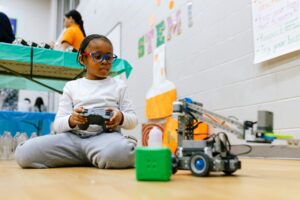 The Direct Instruction (DI) approach to teaching reading and language was paramount when BCP was founded in 1996, and continues to be now. Our founder, Dr. Muriel Berkeley, extensively researched numerous reading programs in her search to help Baltimore City public school students better reach their potential. Her national search led her to DI and Siegfried Engelmann, who, along with Wesley Becker, created this highly structured teaching method in the 1960s at the University of Illinois for at-risk students. DI breaks down the skills through systematic, explicit instructions.
DI is arguably the most researched educational instructional model over the past 50 years. More than 500 studies have explored its effectiveness. Research on DI’s key components and methods—alongside studies of the full program—places them among the most effective practices for improving language arts achievement (Hattie, 2023, Chapter 10). For BCP, its impact has been transformative for the thousands of students who have learned to read and write using DI instruction.
Read more about BCP’s 30-year success with DI and the National Institute for Direct Instruction (NIFDI).
Two years ago, DI was in the national spotlight when the “reading wars” and the science of reading conversation ramped up, as it does every decade. Read BCP President and CEO Laura Doherty’s insights on 2023’s science of reading conversation.
During the November 2025, meeting of BCP Academic Coaches, the group explored the research validation for our reading programs:
BCP Reveal Mathematics Pilot’s Success in Addressing Post-Pandemic Math Gaps
Improving math achievement is a central priority for educators nationwide. Students from K–12 continue to experience a post-pandemic gap in math skills and achievement. In December 2024, the National Assessment of Educational Progress reported that U.S. students are “failing to meet even the lowest level of achievement in math.”
 BCP tacked immediately upon our return to in-person learning and created a plan to address it. In 2023, we convened a BCP-wide committee of math teachers and administrators to do for research-based math programs what Dr. Berkeley had done for reading programs in the mid-1990s.
Our Math Curriculum Committee spent a year researching the needs of our students, reviewing many programs (including those in use across the BCP network), collaborating with national educators and researchers, and visiting schools using math curricula that showed potential. Read more about the Math Curriculum Committee’s work.
Their recommendation? Reveal Mathematics, by McGraw-Hill, for Grades 2-8.
In 2024–25, based on our findings, we launched Reveal Mathematics at three BCP schools: City Springs Elementary / Middle School, Frederick Elementary School, and Pimlico Elementary / Middle School. Govans Elementary School adopted Reveal for the current school year, and Wolfe Street Academy will begin in 2026–27.
A study by Johns Hopkins University researchers, published in 2024, found statistically significant positive effects for students using Reveal Math in grades 3–5 (Cook et al., 2024). In Pre-K through Grade 1, students using the Connecting Math Concepts Direct Instruction program have shown significant growth in both national studies and on our own NWEA MAP scores.
Read more about the BCP achievements from its Reveal Math pilot program and what’s next.
Math Achievement Gains Across BCP Schools
Each of our schools saw student math achievement rise from the beginning to the end of the 2024–25 year. Using Reveal Mathematics, two of our schools achieved their strongest math growth ever on the NWEA MAP test:
- Frederick Elementary reached the 50th percentile for growth—well above scores from any previous year
- Pimlico Elementary / Middle rose to the 55th percentile, compared to the 45th percentile in 2023–2024
BCP schools highlight successful evidence-based practices and share that work with other schools. Pimlico math coaches created and shared math small group planners during the October, 2025 coaches meeting.
Additional BCP Research-Based Programs Strengthening Student Outcomes
Across the organization, BCP leaders and principals rely on research combined with real-time school data to assess curriculum, instruction, and teacher support. Principals use research-backed programs like Restorative Practices and our Community Schools initiatives to remove barriers and create a climate conducive to learning. In fact, BCP pioneered Restorative Practices in City Schools and in Maryland.
Watch the new short documentary “Restorative Practices Make Strong Schools,” City Springs and Hampstead Hill are featured.
BCP’s Coaching Model: Research in Action
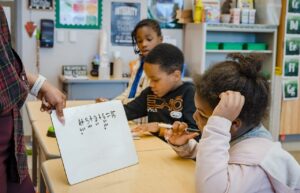 Every teacher in BCP schools, whether they are new or a veteran educator, has on-site academic coaches. Each coach—an experienced former BCP teacher—works one-on-one with teachers during weekly classroom visits. Coaches observe instruction, collect data, and support teachers in interpreting student responses throughout the lesson.
More than 400 studies involving over 8,000 educators show that simply telling a teacher what to do has minimal impact on instructional improvement. BCP’s coaching model goes far beyond directive feedback. Using microcoaching, coaches help teachers closely examine their instructional choices and understand how those choices influence student learning and achievement. This process fundamentally shifts teachers’ thinking about instruction and builds their capacity to become highly effective teachers.
By sharing research-validated best practices and collaborating on student needs, coaches help teachers strengthen their capacity to analyze data and make sound instructional decisions. Together, teachers and coaches refine key instructional moves, building more effective interventions that accelerate student progress and lead to consistently strong instruction.
Watch a video about BCP Coaching for teachers.
Learn more about BCP’s coaching model.
As we look to the next 30 years, BCP will continue to follow the evidence in choosing curricula and programs to ensure that each child learns and thrives.
