News and Press

Meet the BCP Board Member: Ryan Galloway
Ryan Galloway, CPA, brings impressive financial expertise to the Baltimore Curriculum Project (BCP). He’s the managing director of BeMore Corporate Solutions, co-founder and partner of BlackPrint...

BCP Grads Going Places: Courtney Scott, Hampstead Hill Alumna
Courtney Scott: Hampstead Hill Academy, Class of 2020 Attended Hampstead Hill Academy (HHA) from Kindergarten through 8th grade At HHA, participated in the school musicals from 5th-8th grade, Girl...

Student and Celebrity Line-ups for “Are You Smarter Than a BCP Student?”
On Monday, May 13, at the Baltimore Museum of Industry, Baltimore Curriculum Project (BCP) will host a great evening of entertainment, friendly competition, and community engagement at its annual...

Hampstead Hill Academy Breaks Ground for Major Facility Expansion
On April 18, 2024, Hampstead Hill Academy (HHA), one of the highest performing Pre-K through 8th grade public schools in Maryland, celebrated an exciting new chapter: a 12-month construction project...

BCP Community Partner Spotlight: Girls on the Run of the Greater Chesapeake
We truly appreciate each Baltimore Curriculum Project (BCP) partner. They play a significant role in our ability to meet our mission and the missions of our six neighborhood conversion charter...

Wolfe Street Students & WJZ-TV Celebrate the Solar Eclipse
The Solar Eclipse on April 8th was big news around the world, especially at Wolfe Street Academy (WSA). WJZ-TV (CBS News) spent the afternoon with the 114 students who participate in WSA’s Out of...

Frederick Elementary School’s Green Team Blossoms
Last spring, Frederick Elementary School (FES) built its Teaching Garden to help FES students develop lifelong nutritious eating habits by educating them about the connections between their food...

HHA Chess Champions
April has been a banner month for the Hampstead Hill Academy (HHA) Chess Team. The team competed on the local, state, and national levels, where they showcased their talents, tenacity, and teamwork....

The Power of Arts Education at BCP
March is Arts in Our Schools Month across Maryland and the nation. To celebrate, we’re sharing just a few of the wonderful ways that students at Baltimore Curriculum Project (BCP) neighborhood...

Baltimore City Schools’ New PreK CHOICE System
For the coming 2024-25 school year, Baltimore City Public Schools (City Schools) is rolling out a new Pre-Kindergarten (PreK) CHOICE system for families. A goal of the new process is to consolidate...
BCP Board Springs Forward
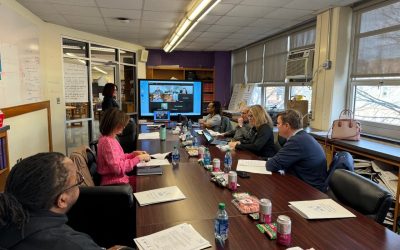
As the 2023-24 school year moves into the sprint of end-of-year activities, the Baltimore Curriculum Project (BCP) Board of Directors is focused on several strategic goals and new initiatives. At...

In Memory: Bob Benjamin, BCP Board Member
Robert “Bob” Benjamin, longtime Baltimore Curriculum Project (BCP) Board member, passed on February 28, 2024. A trusted and talented journalist, Bob was retired as senior editor at T. Rowe Price...
BCP In the News
Check out recent media mentions of the Baltimore Curriculum Project.
WBAL-TV
SNL Cast Member Ego Nwodim and her brother Dr. Emeka Nwodim visited City Springs Elementary / Middle School to launch a series of life-skills-building workshops using improv for City Springs’ middle school Peer Mediators.
BALTIMORE BANNER ARTICLE
Dan Rodricks, Baltimore Banner reporter, writes about Hampstead Hill Academy’s introduction of Yondr phone bags to limit student smartphone use during the school day to enhance academic engagement and increase personal connections and conversations with one another.
CBS NEWS BALTIMORE
Pimlico middle school students learned life-saving Stop-the-Bleed skills as part of the school’s unique partnership with Sinai Hospital, the Pimlico/Sinai Middle Grades Health Sciences Program
UNION TALK PODCAST
Wolfe Street Academy’s Mark Gaither, Principal, and educator Katrina Kickbush, discuss how community schools deliver on the promise of public education with American Federation of Teachers President Randi Weingarten.
WJZ-TV
Discover Pimlico Elementary / Middle School’s unique partnership with Sinai Hospital to give Pimlico’s middle school students a firsthand look at healthcare careers.
WYPR
BCP’s Leading Minds: Challenging Conversations in Public Education symposium on January 23, 2023 discuss violence prevention and the role of the school.
MARYLAND MATTERS
Wolfe Street Academy and Principal Mark Gaither are featured in this story about state school funding for the community school model.
Sign up for our email newsletter